On the Transcendence of Poetic Beauty
I took a class this semester called Phil 248B: Beauty, co-taught by Eric Maskin, Amartya Sen, and Barry Mazur. The seminar was capped at around only twenty students, and structured around weekly lectures, each professor drawing from his own discipline in an exploration of the idea of beauty. I spoke most frequently with Prof Amartya Sen throughout the semester in office hours - our conversations were gravitated most towards poetry, literature, and travel. We spoke about Virgil, Whitman, Shakespeare, Smith, and Kant, which I very much enjoyed.
Perhaps the most fulfilling part of the class was the writing of my final paper, which, apart from entirely deciding my grade, was also a piece of writing that I’d meant to put together for a while now. I’d like to share an edited version now. Some footnotes are missing from the original document, and I hope you will forgive me for any inaccuracies.
On the Transcendence of Poetic Beauty
Initially thought to have been an oral tradition, poetry has survived for millennia through a written medium, certainly in our modern age to be shared across the world and across generations in its transcendence of space and time. When executed well, poetry has the unique ability of encapsulating the human condition into words that cannot be replicated through ordinary language. This paper will argue that poetic beauty arises from its structural features, such as word order, grammatical ambiguity, and meter. Poetry drives audiences to preserve and replicate works they regard as beautiful, due to its power in shaping how we appreciate what it means to be human in their inducing of distinct aesthetic experiences.
In this essay, I will discuss the historical and cultural foundations of poetry, closely examine how Virgil’s Aeneid stands as a manifestation of poetic beauty, and how it relates with Adam Smith, Immanuel Kant, and Elaine Scarry’s conceptions of beauty. Indeed, I shall attempt to theorise about how beauty has survived and continues to be appreciated across the world. Accordingly, I seek to address the question: What is poetic beauty, and why does humanity elect to preserve poetry throughout history?
Poetry seems to elicit emotional and intellectual responses from audiences that ordinary language cannot, because of the distinct ‘poetic license’ that authors are granted. Poetic license is defined as ‘the freedom to depart from the facts of a matter or from the conventional rules of language when speaking or writing in order to create an effect.’ Though prose can have strong persuasive power, techniques such as figurative language, metric devices, and symbolism are often embedded within poetry, thanks to its significant structural freedom. For example, Dante’s epic poem The Divine Comedy (1321) is split into three sections (Inferno, Purgatorio, Paradiso), composed of thirty-three ‘Cantos’ (with the exception of Inferno, with thirty-four), which served to yield an impressive symmetry both within its lines of poetry and in the tripartite conception of the world which Dante created. Dante’s design of cosmic geography, coupled with his literary devices and thematic and political purpose, was a direct influence from his ultimate motive in crafting his poem, as an attempt in pointing at God's perfect design of the universe and the futility of human struggle to fight against supernatural forces. Dante’s work was certainly a product of classical influences as his thematic focus surrounded epic, and could even be interpreted as his own replication or interpretation of the great poets who came before him.
Indeed, in the ancient Greek and Roman worlds, the practice of writing poetry was perceived as a highly intellectual craft (technē), rather than a leisurely, relaxing activity. Greek thinkers understood technē as productive knowledge and a disciplined craft consisting in axioms and poetic structures, combined with the poet’s nuanced understanding of the human condition. Poets were highly skilled craftsmen who manipulated poetic license with intentional precision to create an artwork to appeal to the society of their time.
In many ways, poetry is intentionally designed to surprise the audience with its composition style, unlike the predictable structure of prose. Even subtle techniques such as line breaks or enjambment can intensify a line’s meaning or encapsulate rich details that would otherwise go unnoticed to the untrained human eye, and a common feature of great poetry is that it often reveals increasingly more meaning as it continues to be studied. Poetry has the power to connect a reader with perhaps otherwise forgotten feelings and stimulate introspection in the seeking of a deeper connection with one’s own identity.
This conception of poetry raises some fascinating questions. Can we use poetry to answer the question of whether beauty is subjective, objective, or perhaps relational? Can we provide an explanation for the universal feeling of poetic beauty? To explore these questions, we must first investigate the history of poetry and how ancient thinkers conceptualised poetry.
Historical Context
Despite his suspicions against poetry, Plato describes poets as possessing a kind of technical mastery that powerfully shapes the soul. As one of the greatest philosophers history has observed, Plato proposed that ‘there is an old quarrel between philosophy and poetry’, with the balancing of the two serving as a motif throughout Plato’s works. Aristotle takes it a step further, arguing in the Poetics that poetry communicates universal truths more effectively than history because it represents the essential patterns of human action according to universal laws. For the great ancient thinkers, poetry was a vessel to bear knowledge, a way of understanding the world through a symbolic system.
The survival of poetry is with no small thanks due to its history. Long before written scripts became widespread globally, poetry existed as an oral tradition, composed and performed in communal settings. Rhythmic repetition and poetic meter allowed large bodies of text to be recited and collectively appreciated - consider the image of singing and dancing, accompanied stories being told around a campfire. Many of the greatest poets to have ever lived were said to be blind, such as the Greek Homer and the English John Milton. Poetic form itself serves as a mnemonic device that binds communities together, inviting individuals to take time to commit poetry to memory, preserving shared community values through a medium that could survive in times when written expression was not widespread.
However, due to the emergence of writing, recording works that were once ephemeral enabled poetry to become fixed objects capable of being transmitted across generations, beyond the limits of the fallible human memory. Writing transformed poetry into a craft that could reliably outlive the lifespans of their authors, especially when it can even extend beyond tens of thousands of lines. Copies of original manuscripts were often transported across the world through the centuries by scribes and scholars, which resulted in significantly more reliable original works. The invention of print accelerated this process dramatically, standardising editions of texts and extending their circulation, so that the same poetry could be studied simultaneously by vastly different civilisations worldwide.
Indeed, the history of poetry suggests that it survives because societies have made a collective choice to preserve it. Copying a manuscript, teaching a text, memorising a poem, or choosing between what to carry between countries all represent deliberate acts of valuation, as we will later examine in Immanuel Kant’s conceptual framework of beauty. Each generation collectively votes with its labor and attention for the works which deserve to be preserved. The endurance of great poems is the direct effect of countless individual decisions to preserve the text, whether it be scribes copying by candlelight or readers deriving meaning from the poem and deciding to pass something on (perhaps even analysing them in essays!). This set of cumulative choices form what we now call the ‘canon,’ a body of texts that persists because people repeatedly recognised something worth preserving. We will analyse this with respect to Elaine Scarry’s conception of beauty as work that prompts replication.
Since the Industrial Revolution, the humanities have undergone a significant decline in cultural significance. Upon establishment in the 17th century, institutions like Harvard College once required their students to study generalist curriculums consisting in Latin, Greek, Hebrew, Rhetoric, Logic, Ethics, Politics, Arithmetic, Geometry, and later disciplines such as Astronomy, Metaphysics, and Theology. As countries began to adopt capitalism and encountered economic success, Adam Smith’s 18th century doctrine regarding the division of labour encouraged specialisation and drove self-interest. Indeed, a novel hierarchy of knowledge was ushered in accordingly, in which technical and scientific expertise gradually eclipsed the study of the humanities. The Cold War intensified this shift dramatically: the technological arms race between the United States and the Soviet Union prioritised fields that promised strategic advantage, whether through nuclear weapons testing or aerospace engineering. State investment in STEM fields created a technological ideal that measured value by productivity and utility. As a result, the humanities were perceived as merely ornaments, despite surviving as one of the most vivid ways to articulate the intricacies of humanity that resists quantification.
To understand why poetry endures, we must examine what makes it beautiful, and how its structure serves this purpose. I believe that it is in structural intricacy that poetic beauty emerges, and it is here that we can begin to understand why certain poems elicit continued preservation. To explore this, I will be analysing classical Latin poetry, having studied the language and its literatures throughout high school and at college, with special interest in Virgil’s Aeneid, the national Roman epic which details the story of Aeneas’ journey across the Mediterranean. Aeneas is depicted as the progenitor of the Roman race: an ancestor of Romulus and Remus, the former of which founded the city of Rome, and as an ancestor of Julius Caesar and Augustus.
Close Reading, Virgil Aeneid IV
Classical Latin offers a particularly intriguing window into understanding how poetic structure evokes an appreciation of beauty within a wide variety of audiences. Latin was the official language of the Roman Republic (509–27 BC) and the Roman Empire (27 BC–476 AD), and persisted long after the fall of Rome through the medieval period, the Renaissance, and well into early modern Europe as the language of the law, scholarship, and liturgy (especially the Ecclesiastical Christian tradition). Its longevity means that Latin poetry has been studied and reinterpreted by cultures separated by geography and has survived through centuries of intellectual paradigm shifts, whether it be in Italy, as the language of the Catholic Church, or in universities as the language of study in the medical and legal professions.
Confusingly, the Latin language is indifferent to word order. It derives meaning from connections between disparate symbols that have no meaning on their own, much to the dismay of beginners studying Latin. Each word in Latin can be described in a long string of attributes, such as its case, number, voice, mood, declension, conjugation, principal parts, and person. For example, the verb veniāmus, literally meaning ‘we may come’ or ‘let us come’, is the first-person plural active subjunctive fourth-conjugation (impersonal in the passive) verb, from the initial stem veniō. As Latin is a highly inflected language (these technical intricacies are compressed into just one word!), poets are empowered to exploit their freedom in line structure to create motifs that are revealed only upon scholarly analysis. Indeed, syntactic relationships are encoded in word endings instead of word order, allowing Latin poetry to convey meaning through the way in which words are presented in addition to the words themselves.
Virgil’s Aeneid offers a particularly interesting case study for understanding how this poetic structure generates beauty. The Aeneid was written after decades of civil unrest, following the civil wars of the 1st century BC, such as the brutal Sulla-Marius civil war (83-82 BC), and as Julius Caesar ventured west to conquer the Gauls (58-50 BC), he returned to Rome and declared himself ‘dictator for life’ (44 BC), leading to his assassination at the hands of Brutus, Cassius, and their senators, leading to perhaps one of the most famous civil wars throughout history, between Caesar’s adopted son Octavian (also known as Augustus), and Mark Antony and the Egyptian queen Cleopatra. After his victory following much political instability, Augustus commissioned Virgil to compose the Aeneid to serve as a national epic which traced Rome’s foundation to Aeneas (glorifying the Roman Empire), aligned with Augustus’s political goals of creating a new era of peace and order. Indeed, we now refer to the time after Augustus’s rule as the ‘Golden Age of Rome’, an unprecedented level of political stability and economic prosperity in the Roman Empire, and the revitalisation of cultural flourishing, as can be seen in achievements in law, art, architecture, and infrastructure like aqueducts and roads.
In his depiction of Aeneas’ character, Virgil represented the ideal Roman virtues of clementia (clemency), patria (duty), pietas (piety), and gravitas (gravity). Presented as a goddess’ son (Venus), Aeneas is depicted stoically as he journeys across the Mediterranean following the Trojan War, carrying his household gods (Penates), the survivors of the Sacking of Troy accompanying him as he seeks to build a new kingdom for his people. Virgil and Augustus’ relationship was symbolic - a poet who believed in the promise of a new ruler’s vision for Rome and an emperor who used literature and virtue signalling to legitimise his reign. Historians believe that Virgil first wrote the Aeneid in prose, and then parsed through each line and adjusted the poem to conform to the rules of dactylic hexameter accordingly. Virgil’s decisions on word order and word choice were highly elaborate and sophisticated - as a perfectionist, even on his deathbed, Virgil requested for the Aeneid to be burned, citing the reason that he hadn’t yet finished it.
Virgil’s Aeneid is considered by many, certainly including this author, to be one of the greatest poems ever composed. With its particular historical context, the Aeneid captured the minds of Roman society, and has also endured for millennia, influencing literature as a result which stand in their own right as era-defining works. This is in no small thanks due to Virgil’s masterful poetic style which prompts deeper readings into a small section of poetry. Nowhere is this more evident than in Book IV, where Virgil shifts from navigating the storms of the Mediterranean to the emotional and theological complexity of the relationship between Aeneas and Dido, the Queen of Carthage. The book’s beauty lies in its tragic storyline and the structural techniques through which Virgil conveys the ideas of divine will and fate.
Book IV of the Aeneid stands as one of the most studied passages in Latin literature, largely because of how clearly poetic beauty is able to emerge from Virgil’s curated semantic ambiguity. A close reading of its structure will demonstrate how he embeds multiple layers of meaning into just a few words of poetry. Yet, these structural features cannot guarantee beauty. As we will come to see, poetic beauty emerges unpredictably from the interplay between craft and audience.
Close Reading 1 (Aeneid IV.124)
‘speluncam Dido dux et Troianus eandem [deveniunt]’ translates literally to: ‘Dido and the Trojan leader descend to the same cave.’ This line appears deceptively simple upon first sight, with its poetic structure completely neglected when a reader engages with Aeneid in translation. Translating the words of the line directly without taking word order into account, the line reads ‘cave Dido leader and Trojan the same [they descend]’, which seems to be complete nonsense. But the Latin language operates by connecting these symbols with logical axioms. The accusative singulars ‘speluncam’ and ‘eandem’ agree with each other, and we can see that the nominative ‘Dido dux’ and ‘Troianus’ are in the nominative singular. The nominative case denotes the subject of the clause, and the accusative case denotes the object. Hence, we can join these words: ‘Dido and the Trojan leader’ is our subject, and ‘the same cave’ is our object. With the verb ‘deveniunt’ on the next line, we notice that we find ‘speluncam’ and ‘eandem’ on opposite sides of the line. They are the first and last words we see when we read, respectively. Virgil writes of the two leaders literally descending into a cave that now surrounds them, but has manipulated the word order and meter so effectively that he has been able to metaphysically have the words for ‘the same cave’ surround Dido and Aeneas.
This is especially impressive, considering the strict metrical guidelines required by dactylic hexameter. It will be challenging to fully explain this particular metrical scheme in a relatively short essay on beauty, but I shall briefly describe it. Each line in Latin poetry is divided into six metrical feet, with each foot as a spondee (two long syllables) or a dactyl (one long syllable followed by two short syllables). The last two feet must be a dactyl, and then an anceps (a long syllable followed by another syllable, which can either be short or long). This leads to some interesting poetic results: in Aeneid I, 117-118: ‘torquet agēns circum et rapidus vorat aequore vertex || appārent rārī nantēs in gurgite vāstō.’ Line 117 has four dactyls! The run of three dactyls in ‘et rapidus vorat aequore’ (and the swift sea devours) echoes the speed with which the whirlpool devours the ship. In contrast, line 118 has five spondees, the maximum number that appears in hexameter. The slow, heavy rhythm adds to the pathos, as the audience lingers on the sight of the drowning men. These lines have a strong rhythmical contrast, and it is by no accident that Virgil decided to contrast these two lines in close proximity.
Additionally, the placement of ‘dux’ (leader) right after Dido, separated by the conjunction ‘et’ (and) is intriguing and deserves further study. When we scan the line by the rules of dactylic hexameter, we find that the caesura (the break between words in a metrical foot) lands directly on the third foot, the dactyl starting with et // (Caesura) Troianus, further emphasising the divide between the words ‘Dido dux’ and ‘Troianus’. However, ‘dux’ agrees with ‘Troianus’, and is very clearly in reference to the Trojan leader Aeneas! Indeed, Virgil strategically placed ‘dux’ adjacent to Dido to embed symbolism into the power roles and gender dynamics at this point of time in the book. Dido, as the queen of Carthage, was madly pursuing Aeneas as a romantic partner due to Cupid’s shooting of a love arrow into her earlier in the poem.
The word order here becomes a miniature enactment of the larger tragedy of Book IV - Dido’s apparent control is illusory, her agency compromised by passion and the divine machinery of fate that ultimately sides with Aeneas. Though Aeneas has not made the decision yet to abandon Dido in Carthage, the subtle foreshadowing of Dido’s powerlessness is exquisite yet subtle. In only a single line of poetry, Virgil has powerfully engineered a tension between a line’s semantics and its place within a poem’s structure, compressing an entire psychological and political commentary that is lost in translation.
Close Reading 2 (Aeneid IV.65)
‘heu, vatum ignarae mentes!’ translates literally to either ‘alas, the minds ignorant of seers!’ or ‘alas, the ignorant minds of seers!’ Again, we encounter another incredibly simple line upon first sight that would otherwise go neglected when reading the Aeneid in translation. The editors of each translation of the work make their own choices on how to most accurately translate Virgil’s work, informed by the scholarship available to them at the time. But when studied in the original Classical Latin, there is a clear ambiguity when deciphering this particular phrase, and it is unsurprising that modern day scholars are divided on interpreting it.
For most audiences, it seems relatively unimportant which particular translation we should elect to adopt. Virgil has employed the use of the genitive plural ‘vatum’ (seers/prophets), which generally indicates possession. Here, we can interpret ‘vatum’ as either a subjective or objective genitive - the subjective being ‘ignorant minds of seers’, the objective being 'minds ignorant of seers.’ This line is still ambiguous, and it is clear that this was a consciously crafted Virgilian decision. Decoding the grammar of this line functions exactly as a linguistic puzzle, and minute changes in attributes as seemingly insignificant as the case of a noun or in word order can drastically change the meaning of a line, and by extension, an entire poem.
Virgil introduced this grammatical uncertainty at a decisive point in Aeneas’ journeys. As the Aeneid dives deeply into the thematic constructs of divine will, fate, righteousness, and piety, the interpretation of this line is particularly important. Some scholars argue that it refers specifically to Dido's ignorance of divine warnings in her haste to wed Aeneas and hold him in Carthage in defiance of his preordained fate to found a new Rome, while others suggest it applies more generally to the nature of love itself as a blinding and overcoming force. Personally, I am not sure what interpretation to believe, but I am incredibly content surrendering myself to the ambiguity that Virgil originally composed this line with and marinating in the act of theorising about his purpose.
In a way, poetry defies the rationality that humans are generally accustomed to, as we would struggle to create semantic meaning from the poetry that we read if we only had access to a set of axioms that govern how grammar and word order should be interpreted. Ambiguity which transcends logic and rational thinking is a testament to the features of poetic technique that is certainly not limited to the Latin language. The tragedy of Dido, one of the most heartbreaking in all literature, rests on failures of knowledge and the black box nature of divine intention. Virgil has commentated on his own work by compressing that entire thematic structure into just three words, featuring a deceptively simple genitive. His ambiguity invites the interpretive labour that makes poetry beautiful and endlessly reinterpretable, curating certainly uncoincidental moments of hesitation for audiences.
Virgil’s Poetry and Beauty
Virgil routinely manipulates grammar and word order to create what Altusser refers to as overdetermination, applied to a semantic context. What this means, loosely applied, is that lines of poetry in Latin can mean more than one thing at once, and its beauty lies precisely in this excess. In translation, an interpreter must choose how to parse through ambiguity. However, when reading poetry in the original Latin, one has the opportunity to experience the moment where the poem refuses to resolve itself. In this case, the ambiguity itself reflects the uncertainty and otherworldly divinity that characterises Book IV of the Aeneid.
Beauty seems to arise from this intellectual recognition of structure, when audiences are forced to participate in interpreting a text, instead of passively absorbing it. Poetry persists because humans wish to preserve conduits that produce dense experiences of humanity, and poetry is special in that it is able to compress vivid conceptions of the human condition into compact lines, which have the power to stay with audiences long after they are first read. When a poem creates multiple layers of meaning simultaneously, it is challenging to resist dwelling on how different people, with their own life experiences and conceptions of identity, could perhaps engage differently with the same material. The enduring power of poetry lies in its ability to channel the human condition through a structured art form.
Adam Smith explores these ideas in the ‘The Theory of Moral Sentiments’ (1759), by examining why certain characters and virtues become immortalised throughout society. Smith argues that we are moved by what ‘excites our admiration’, referring to displays of virtue that affect audiences because they reveal essential truths about human nature. His description of moral responses to these ideas explain why poetry is so widely appreciated in their most structurally intricate forms. When Virgil crafts lines which resist simple interpretations and mandate deliberation, he creates examples of Smith’s foundational theories. Audiences identify with virtues foundational to admiration, such as judgement, piety, courage, and sympathy in trying conditions.
This offers a deeper explanation for why poetic beauty persists across centuries. Over the long term, while humans often appreciate texts that are entertaining, there is a deeper collective choice that is made when they preserve the structures of admiration and understanding that Smith describes.
Poetry’s formal density is what enables these repeatable experiences of comprehension. When we each undertake the arduous task of learning the Latin language, we share in the same struggle of interpreting ambiguous lines and word order. Smith proposes that sympathy is a foundation for our senses of morality - in reading poetry, we come to appreciate the diverse perspectives of authors and fellow audience members by sharing our individual readings of the same work. The admiration we feel toward a beautifully structured poem stands as a recognition of a common humanity that is able to be moved by art. We admire the product of the mind itself, capable of producing such coherent complexity. Smith’s account explains why lines such as Virgil’s are re-examined and preserved over time, as admiration generates the impulse to sustain a work across generations.
Kant and the Universal Subjective
Poetry can only survive due to a series of conscious decisions made by its intended audiences. We would be completely oblivious to even the Aeneid’s existence, if it weren’t for audiences who chose to preserve the text for the next generation. In the Critique of Judgement (1790), Immanuel Kant describes the idea of the universal subjective. Formally, this is the idea that while judgements of beauty stem from subjective feelings (pleasure/displeasure), they claim universal validity, implying that everyone should also judge something to be beautiful. To deem something beautiful, you would assume that everyone else in the world would also find it subjectively beautiful. Individual judgements, all sharing in the same excitement.
We cannot preserve all literary works over time, but rather, we choose what to carry forward. The survival of Latin poetry is not the result of any single joint decision, but of countless individual acts of making decisions to value it. They represent a critical mass of choices that together determine what is worth remembering. This is what makes epic poetry valuable and worthy of analysis - it has survived over thousands of years, and we have put resources into preserving the texts (time, money, paper) because it is universally subjectively beautiful. Poetry thus transcends individual humanity as just ‘ink on a page,’ but also represents our shared human experiences, encapsulated into language that can be revived throughout time in audiences' minds.
Interestingly, Kant also claims that genius is God giving their rule to art. Writing becomes a kind of transcendence, a moment where the human and the divine intersect, and hence when we face a poem of genuine beauty, we sense something supernatural operating through the poet. The lines of poetry seem to arrive from a divine source, as the poet becomes the means by which language rises out of the mundane. In the moment of reading great poetry, the reader stands before a work that feels both historically situated and timeless, crafted in human hands yet pointing upward to something larger than what humanity is able to conceive. Beauty, in this Kantian sense, is something supernatural, leading to a shared appreciation within society that motivates emotional and literary responses. Indeed, poetry is preserved because a mass of readers repeatedly experience this shared appreciation for transcendence.
Beauty Prompts Replication
In “On Beauty and Being Just” (1999), Elaine Scarry claims that a key feature of beauty is that it prompts replication, a natural response to the experience of beauty itself. When we come across poetry that we consider beautiful, we can understand that this replication impulse is a fundamental feature of beauty. Poetic beauty naturally invites replication, whether it be memorisation and recitation, transcription by scribes, the copying of manuscripts, translations so that those of other cultures can appreciate the same works, or scholarly commentaries and university departments dedicated to the study of classical literature.
Virgil’s Aeneid may be an extreme case in the discussion of replication, as it has served to inspire many other highly influential works throughout the Western Canon. Most notably, Dante’s Divina Commedia, a tripartite epic poem wherein Dante, guided by Virgil, journeys through the circles of Inferno, Purgatorio, Paradiso is both literally and metaphysically influenced by Virgil’s Aeneid, and those who have been lucky enough to appreciate both pieces of work notice intricate details and intertextuality within both works.
Similarly powerful is the poetry of the 19th century American poet Walt Whitman, his greatest work a poetry anthology titled Leaves of Grass (1855), written in a time when America was a young, developing nation which lacked its own cultural identity. Politicians had founded the country just decades earlier following the Revolutionary War against Great Britain, and the nation was still trying to derive its own cultural mythology.
When Leaves of Grass was composed, America was a country fractured over slavery and Whitman’s poetry tried to hold the country together with a vision of unified humanity. Whitman rejected meter and wrote in free verse, a form as open and democratic as the country he celebrated, positioning his Leaves of Grass as a modern continuation of what Virgil began, by using poetry to forge national identity. As Virgil reshaped Rome’s trajectory through the divine lineage and imagery of Aeneas, Whitman reconstructed America’s destiny through celebrating the individuality of the people themselves. Virgil’s singular hero is symbolic of what common people should strive towards, whereas Whitman dissolves the individual hero into a collective democratic identity. As one of Whitman’s most famous lines dictate, “Do I contradict myself? Very well, then I contradict myself. I am large, I contain multitudes”, he celebrates the intense individual endeavours that now distinguish America from the remainder of the world.
Both poets have powerfully utilised language as a cultural technology, binding the past to the future, and articulating what their civilizations value, fear, admire, and hope for. Whitman is documented as having read Virgil extensively, and no doubt was inspired by the state of the Roman Empire at the time, driven to replicate the immensely impactful work of Virgil. Whitman’s free verse is a natural reimagining of Virgil’s work, as he expands the epic to fit the democratic age of America at the time.
There is certainly a strong, inherent impulse within great poetic beauty that moves individuals toward the act of replication. Indeed, due to its structure and figurative nature, the overdetermination of poetry means that it is inherently easier to memorise, transmit orally, demand re-reading and re-interpretation, and reward both students and scholars to preserve. Scarry’s framework clarifies the mechanism by which beauty persists - that is, structural pleasure generates a desire to reproduce the work in new forms through reinterpretation.
Bringing It All Together
So far, I have argued that beauty exists innately in beauty due to its structural encapsulation of the human condition into a short volume of words. Poetry is a literary form which invites repeated interpretation, and prompts replication across time and cultures.
However, I think that the most vivid manifestation of poetic beauty is the cases in which humanity chooses to engage with it. Beauty stands as a means for humans to decide what is valuable to them and what they wish to provide as offspring for future generations. In Plato’s Symposium, he claims that humans have two types of offspring - first is their biological offspring, or their children, as genetics are able to survive for generations, but the second is their literary work, which can be passed down through generations as deemed appropriate by those in society. As humans are inherently limited by resources, we must make the conscious choice of what is best representative of the human condition at the present moment, and make decisions of what we think is worth preserving.
It is because certain poems claim a kind of universal shareability of pleasure, and can connect with so many people of different backgrounds and livelihoods that they are so relatable and were deemed worthy of preservation by a critical mass of citizens across the world and across time. If humans do not make this choice to preserve poems, then regardless of how great a poem might have been throughout history, we cannot pass it for the next generations to come, and hence the poem dies into the abyss with its audience.
This idea is quite confusing - what seems to be decorative artwork, which can just be perceived as ink on a page or colours on a canvas, can evoke such vibrant emotions across not only one person, but anyone who has had the chance to appreciate said artwork.
Society is affected deeply by our perceptions of poetic beauty, though this may seem unconscious at first. Beauty expands our capacities for attention and care, as we pause over the perception of virtues and ways in which we can live. Take the great example of Aeneas carrying his immobile father on his shoulders, leading his son Ascanius and wife Creusa out of the burning city of Troy, having been sacked by the Greeks in their Trojan Horse in the events of Book II in the Aeneid. Aeneas is not only carrying his father, his ancestor, but also the household gods (Penates) that he believes in. The level of stoicism, piety, and virtue depicted in this image, when one considers that Aeneas was told to flee by the Roman Gods in a dream that he had earlier, and how he will lose both his wife and his father shortly after this scene, only makes it more moving and harrowing of an image.
All this was conjured through the tedious yet rewarding process of parsing through and translating Latin poetry, and it is no surprise to me, having finished reading through the Aeneid in recent years, that this epic work has survived for millennia. Across time, poetry sustains cultural images that the poet wants to preserve so that human civilisation can continue to appreciate it. Indeed, poetic beauty is democratising, as anyone can participate in its creation and interpretation, and anyone can be driven to replicate it as well.
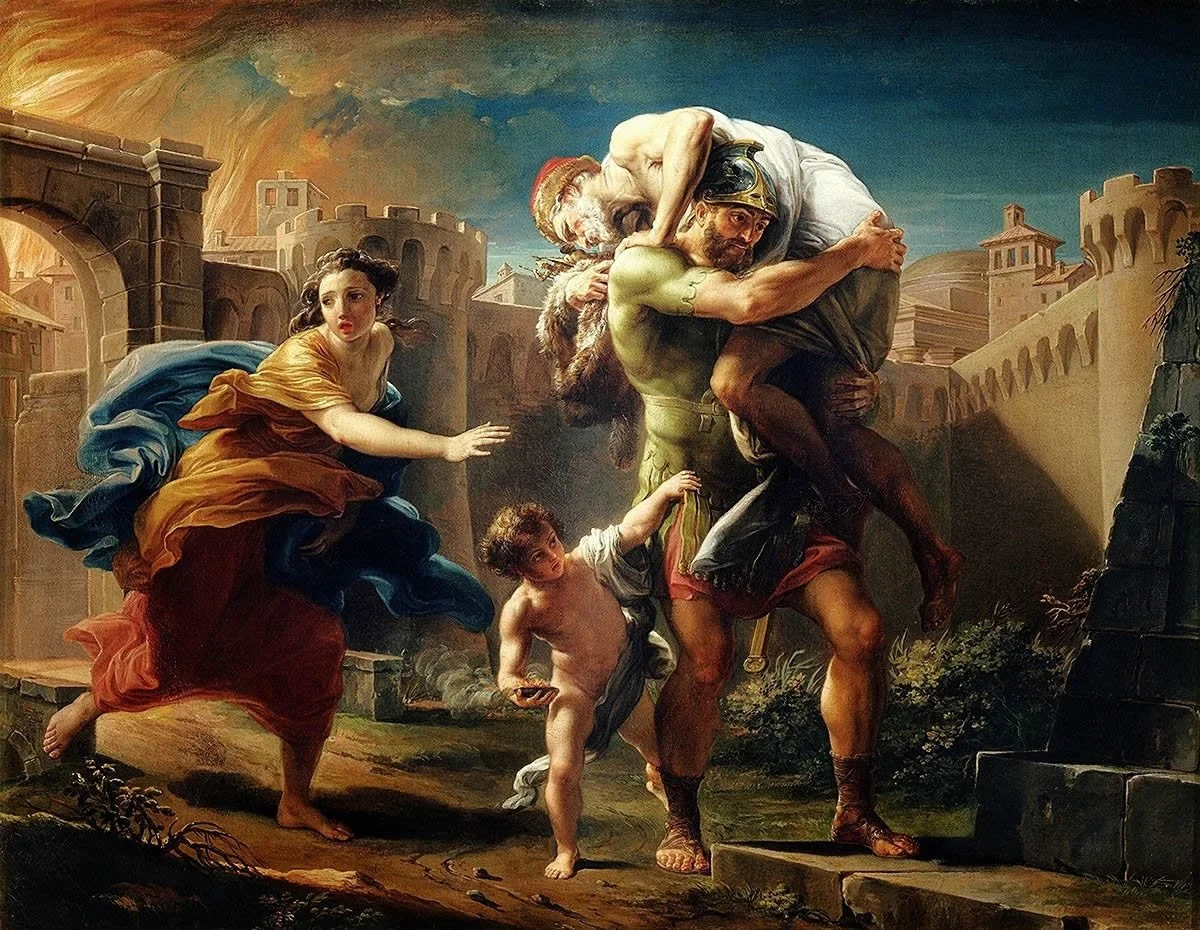
Figure 1: Pompeo Batoni (1708–1787), Aeneas Fleeing from Troy (1753), oil on canvas, 76.7 × 97 cm, Galleria Sabauda, Turin, Italy.
This leads me to an interesting philosophical question - how should artists and poets decide what to write about? If Smith, Kant, and Scarry all have their own criteria on what defines beauty, whether it be as a means to admire for human excellence embodied in structure, a ‘universal subjective’ claim that seeks assent, or artworks that prompt replication, how should poets that aspire to craft poetry use these frameworks to help them write? Is there a way to seek beautiful poetry? This leads us to one of the most challenging questions in the study of aesthetics - is beauty in the eyes of the author or the recipient? Is beauty a quality that we consider subjective, objective, or relational?

Figure 2: Henry Fuseli (1741-1825), Odysseus Between Scylla and Charybdis (1796)
I argue that it is not possible to manufacture beauty, despite the frameworks that I have examined throughout the course of this paper. There is no way for us to assume that even the greatest poems we write will be accepted by humanity and will prompt them to recreate beauty, or that they will interpret our work as depicting virtue. We cannot create things in the hopes that they are preserved for future generations, and we cannot appeal to human virtues as we know them because of the scale of the world and the disparities between cultures.
And on the contrary, we also may find it hard to write poetry completely from our own lens. The incorporation of intertextuality from the perhaps niche texts we come across from our reading habits and cultures, or subtle personal references from our childhoods that we use to create poetry that is overdetermined and hence worthy of analysis and re-reading will likely read as convoluted text that has limited meaning to those that are not the original poets.
How is it possible for us to navigate between these figurative Scylla and Charybdis? How does the poet proceed in his attempt to craft his own poetry? He risks excessive personal specificity and obscurity on one side and a craft that can likely no longer be considered poetry on the other. Both extremes lack respect for the shared transcendental experience that beauty requires. To deeply connect with an audience, rich poetry must elicit admiration, universality, and replication.
I believe that the poet writes most effectively not by attempting to manufacture beauty, but by creating the conditions under which beauty may arise, and writing for themselves all the same. This is the most influential lesson that I have learnt from studying aesthetics in recent months. Beauty emerges from a poet’s intentional, yet unintentional craftsmanship, when their imagination leads to a poetic form and thematic judgement that produces a work that captures aspects of their lives in so pure a way that audiences can’t help but appreciate.
The perplexing part of this idea of the poetic craft is its absolute irrationality. Beauty is a phenomenon that is out of the poet’s control. The poet cannot guarantee that a poem will be preserved, nor that it will speak across cultures, but they can shape a structure that invites the reader to engage in imagining with the poet across time and space, and make room for intertextual and scholarly reinterpretation.
Using this conception of poetic beauty, we can view the art of writing poetry less as the object we call ‘poetry’, but rather as a ritual prepared by the poet in which something transcendent might occur. The act of surrendering one’s judgement in composing poetry by unobstructing the mind and allowing words to flow onto paper will lead to poetic beauty at a much higher frequency than poets who declare that they will write something beautiful and use conceptual frameworks to manufacture it. This speaks to the paradoxical nature of beauty, as something that cannot be pursued or created purposefully. Instead of serving as a bound or limitation to great poetry, this stands as the very reason why beauty remains worth pursuing. If we could produce beauty at will, it would cease to be so, and society would be inflated with an abundance of poetry that none would consider worth preserving.
Beauty escapes intentionality, yet it requires serendipity and purposeful drive for capturing the intricacies and nuances of humanity, encapsulating it in a small portion of literature. The poet must labor unabashedly, knowing that the intended outcome of beauty lies beyond him, and yet have an irrational faith that his fruits will come to bear. Even if it does not, the poet must trust that their act of surrender will have created something symbolic and meaningful for themselves.
Conclusion
The modern world is dominated by an obsession with optimising and treating creative processes as means, rather than ends themselves. We now live in an age that is dominated by yet another arms race for progress in the generative artificial intelligence market. Humanity is plagued by a state of uncertainty, where we cannot even trust the authenticity of artificially generated artworks, and are left to reckon with the effects of artificial intelligence in a society that is constantly evolving.
The frameworks of Smith, Kant, and Scarry illuminate different facets of the same phenomenon. Structures of language attract our admiration, reach for a universal subjective appreciation of it, and prompt replication to reimagine ancient texts. Together, these accounts reveal why poetry is preserved across generations. The case of Virgil’s Aeneid is perhaps one of the most compelling. In its original Latin, the poem compresses more meaning into a single line than translation can bear, whether it be Dido and Aeneas surrounded by ‘the same cave,’ the ambiguous ‘minds ignorant of seers,’ or the image of Aeneas carrying Anchises out of burning Troy. These are lines that compel humans to come back to them and demand slow, careful scholarship. When later poets like Dante and Whitman take up Virgil’s images and recast them for their own cultures, they acknowledge that something in Virgil’s poetry still has the power to orient our attention and shape our imagination.
Beauty cannot be manufactured, but this should not serve as a blockade to poets that wish to share their creativity with the world. The poet’s call to action should not be to design a work that will guarantee admiration for centuries to come, but instead to do justice to the unique human experiences they wish to capture through structure, syntax, rhythm, and ambiguity. Beauty, when it does manifest, appears as a grace, between a crafted structure composed by a poet and his audiences that stumble across it, who take the time to appreciate and revisit it across time, perhaps driven to reimagine it. We cannot command beauty as a characteristic to be injected into artwork, but we can place ourselves in intentional states of minds and write without embarrassment about our lives, and hope that later readers will appreciate our little pocket of what it means to be human.
In the end, poetry survives because it is one of the purest forms of human expression, as we are invited to think deeply about ourselves and the state of the world. Those who make the conscious choice to appreciate poetic beauty are invited to constantly wrestle with the linguistic ambiguity and literary symbolism that poets have encapsulated in just a few words, and are hopefully inspired to go forth and recreate their own pockets of our shared humanity.
What makes poetry beautiful is the way that its structure stands as a manifestation of humanity’s attempt to make sense of the world under uncertain conditions. Perhaps language can be recombined at scale using artificial intelligence, but a large language model cannot, by itself, bear the lived risk and vulnerability of personal literary expression, make conscious decisions about how to encode rich layers of meaning into only a limited number of words, or sustain the labour of attention that went into Virgil’s hexameter or Whitman’s free verse.
This paper is succinctly summarised by just one quote, from Johann Wolfgang von Goethe:
“In ordinary life, we get by with language just adequately, because we only describe superficial relationships. But as soon as deeper relationships are at stake, another language rises at once: the poetic."
The persistence of poetry reveals something stubborn about our humanity. We often choose consciously to make irrational choices and preserve that which may appear to have no utility, and serves a purpose that is not just ornamental, but rather, beautiful.
Yurui Zi
Jan 7th, 2026